
The Short Story: (read over a coffee)
The auDA Board approved, in principle, the deletion of subparagraph (f) of clause 2.4.4(2). That is the rule that lets a ‘com.au’ or ‘net.au ‘name match a service, a good, an event, an activity or premises. On 19 October 2026 auDA proposed to spare people who already hold a name, and to apply the new test to everyone who comes after them. No final decision has been made. Ron Jackson at DN Journal called it a reversal for current registrants only, and asked the question auDA still has not answered: if the name is sold, does the buyer keep the old rule?
The registrars did not ask for a carve-out. Twenty-one of the 28 David Warmuz canvassed signed one letter telling the Board to reverse Recommendation 2 and keep (f). Their test of real names against the Match and Acronym rules that would survive produced a failure rate of 50 to 80 per cent. On nearly 3.5 million ‘com.au’ and ‘net.au’ names, that is 1.7 to 2.8 million they say were compliant on the day they were registered.
Matt Healy chaired the Panel, voted to delete (f), and sent the report to the Board. The minutes of 28 August 2025 show the Board approving the panel he put up, with Brett Fenton in the room. A year later that Board accepted the recommendation. Fenton has already said, in his own name, that domainers “create nothing” and that the monetisation policy and the end of the resale ban were “the most detrimental policies in the space since deregulation in 2002.”
While the registrars are in the room, the same Board is asking members, at the 19 November 2026 AGM, to lift the director pay cap from $690,000 to $933,900. That is 35 per cent. A full board on the current schedule is already about $678,000. The August pay review has not been published. Fenton, who sits on the committee that reviews director pay, is up for reappointment at that same meeting.
Publish the count of names that stand on (f).
Publish the pay review.
Say whether a buyer keeps the old rule.
Keep (f).
The auDA Board MUST notify all potentially affected registrants!
…
The Full Story: (read over lunch!)
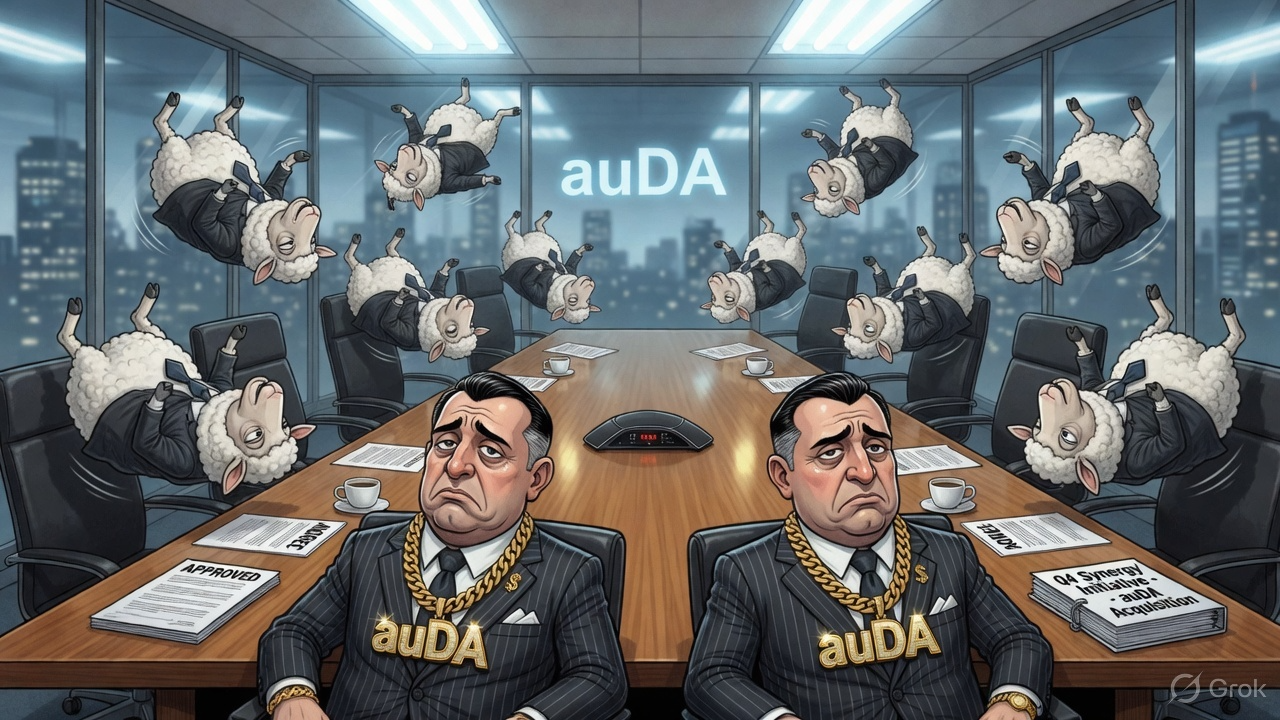
The auDA Board sat with Matt Healy (Chairman of the Licensing Review Panel), took his recommendation to ruin the Australian domain name space (as widely reported), and then asked for a 35% pay rise.
We said the auDA Board would be proven incompetent the moment it backflipped on deleting subparagraph (f) of clause 2.4.4(2).
The backflip has started.
It is a half-backflip. And while the registrars are walking into the room this week to tell the Board what that clause is worth, the same Board is asking members for a larger pay ceiling.
On 21 October 2026, Ron Jackson at DN Journal put the headline on it: Under Pressure auDA Reverses Misguided Course on .AU Domain Names But Only for Current Registrants. His words:
auDA has decided to grandfather existing registrants in by giving them an exemption from the rule, but any new registrants of .com.au and .net.au domains would have to meet the onerous new requirement.
He then asked the question auDA still has not answered. If an existing name is sold, does the buyer keep the exemption, or is the buyer a new registrant? If the buyer is a new registrant, the aftermarket in ‘com.au’ and ‘net.au’ is the thing being cut.
auDA’s own sentence, which Jackson also quoted, is weaker than his headline. No final decisions have been made. Consultation is still to come. A proposal to spare the people who already hold a name, and to shut the door on everyone who comes after them, is not a reversal. The registrars did not ask for a carve-out. They asked the Board to keep the rule, to keep subparagraph (f) of clause 2.4.4(2).
What the Board actually accepted
Clause 2.4.4(2)(f) is the allocation path that lets a ‘com.au’ or ‘net.au’ name match, or be a synonym of, a service, a good, an event, an activity or premises the registrant is providing. It has been the lawful way to hold a product name, a campaign name, a short email name, and a generic. Monetisation in ‘com.au’, ‘net.au’ and .’au’ direct is a separate rule, and the Panel’s own Recommendation 1 was to keep monetisation. Recommendation 2 then deletes the path most of those names use to qualify. Keep the activity. Remove the doorway.
On 20 July 2026 the Panel voted. The minutes name the votes. Option 3, delete (f): Ian Kelly, Selvi Kannan, Ross Creelman, and the Chair, Matt Healy. Four. Option 1, keep the rule and enforce it: Erhan Karabardak and Niluka Welungoda. Two. Anthony Peake abstained. On 18 August 2026 Kelly moved the Final Report, Creelman seconded it, and it went through 6–1, with Peake the only vote against. Healy told the minutes he would send it to the Independent Chair for the Board meeting of 27 August 2026.
auDA then published the result. At its August 2026 meeting the Board approved the Panel’s recommendations ‘in principle‘ and told management to write an implementation plan. That is the decision 21 registrars have now asked the Board to reverse.
Read the minutes and you will find a guy called Brett Fenton was in the room.
This is not a rumour about a friendship. This is the attendance list.
Board minutes, 28 August 2025 (https://files.auda.org.au/documents/28-August-2025-Board-Minutes.pdf). Present: Alan Cameron, Peter Elford, Brett Fenton, Sandy Davey, Sandra Hook, Claire Rogers, Thu-Trang Tran, Mike Trovato, Tina Wyer, Wendy Thorpe. In attendance for item 11.4: Matt Healy, Licensing Rules Review Panel Chair.
The minute says:
The Licensing Rules Review Panel Chair joined the meeting to provide the Board with an overview of the process to source Panel Members and confirmed that the candidates reflected the range of stakeholder groups set out in the Policy Advisory Panel terms of reference.
The Board resolved to approve the appointment of the candidates proposed by the Chair of the Policy Advisory Panel as members of the Policy Advisory Panel 2025 to undertake the .au Licensing Rules Review.
Matt Healy is a former auDA director. He left the Board in 2023. In August 2025 the Board he used to sit on brought him back into the room, heard him, and approved the panel he put up. A year later that panel, with Matt Healy‘s own vote in the four, recommended deleting (f). The Board he had just briefed accepted the recommendation in principle.
Brett Fenton was a director in that room on 28 August 2025. He has been a director again since November 2024. He was a director once before, from November 2005 to October 2007. On 19 November 2026 the same AGM that votes on the pay ceiling is the meeting at which his new term as an appointed director begins. He sits on the Governance and Culture Committee. That committee reviews directors’ remuneration and recommends it to the Board. He also sits on Security and Technology.
The man, Brett Fenton, who will be reappointed at the pay-rise meeting was in the room when Matt Healy‘s panel was approved, and he sits on the Board that took Healy’s recommendation.
And, Brett Fenton has been telling everyone for years what he thinks about Domain Investors (‘Domainers’).
Fenton posted this on Ned O’Meara‘s ‘Domainer‘ blog on 26 April 2016, at 8:12 pm, and marked it as his own view. The comment is still there. (https://www.domainer.com.au/justifying-the-end-result/#comment-1842)
Ned, domainers on the whole create nothing, add zero value to the space, and exist solely because of market inefficiency trading on effectively an arbitrage. At some point the market always overcomes inefficiencies and the ability to profit from arbitrage disappear. That’s basic market economics. I’d say you and the domainer community are rightly terrified that second level registrations screw your business model, maybe that’s a better conversation to have, rather than disingenuously speaking on behalf of small and micro business who you routinely exploit.
On 7 September 2016 he pointed Whirlpool at that comment and repeated it. whrl.pl/ReHZfC (https://whrl.pl/ReHZfC).
On 5 April 2018, posting as Brett Fenton of Netregistry Group, he aimed this at the monetisation policy and the removal of the ban on resale. whrl.pl/Re7Tkf (https://whrl.pl/Re7Tkf).
These policies have been the most detrimental policies in the space since deregulation in 2002. They have what allowed your cybersquatting mates into the space. The introduction of these policies benefited basically no-one except a few small number of people.
Six minutes earlier, whrl.pl/Re7Tjh (https://whrl.pl/Re7Tjh), he sneered at “the arbitrary valuations placed on domains by domainers” and called the people he was arguing with the “cybersquatting community.” He also restated, as “the full quote”, the line from his 2015 TPP Wholesale post: domainers buy domains purely to sell later at a profit, and monetise the traffic.
That is Brett Fenton’s view. It is a decade old. It is in his name. It is the view of a director who was in the room when the panel that voted to delete (f) was appointed.
Hold it next to his earlier words, because he has had both positions.
On 3 April 2006, writing to auDA for Netregistry, he said: “In summary NetRegistry supports the use of domains for the purposes of generating traffic.” The archived submission is here. (https://web.archive.org/web/20170228012745/https://www.auda.org.au/assets/Policies/Policy-Reviews/200603/fenton3.txt) On 17 January 2012 he wrote, on Whirlpool: “Monetization != cybersquatting.” whrl.pl/Rc3Er8 (https://whrl.pl/Rc3Er8).
He knew the difference. He later decided the policies that allowed it were the most detrimental since 2002. The Board he sits on has now accepted, in principle, the deletion of the allocation path those policies rely on.
The registrars did not whisper
On 15 October 2026 Andrew Allemann at Domain Name Wire reported that registrars had written to the Board. His piece is here. (https://domainnamewire.com/2026/10/15/domain-registrars-push-back-on-australian-domain-name-changes/) He had the right letter and the wrong headcount. He wrote “ten registrars” and named only Tucows. The letter itself says the signatories are on an attached page.
David Warmuz, (who runs the one-and-only premium Australian domain name drop auction as an auDA accredited Registrar) who has been in the middle of the registrar count, put the number on LinkedIn a week later. 21 registrars out of the 28 signed the letter. One more agreed and is sending its own. Three agreed and were waiting on lawyers. One was waiting on management. Twenty-one signatures is not a fringe.
This is the letter. It is undated. It is addressed to the Board and we believe it was presented to the auDA Board late week. The copy we print below ends at the signatory page. The words do not.
The Board of Directors
.au Domain Administration Ltd (auDA)
Re: Recommendation 2 of the .au Licensing Rules Review
Dear Members of the Board,
We, the undersigned accredited .au registrars, write about the auDA Board’s acceptance in principle of Recommendation 2, which would remove the ability for domain owners to meet the .com.au and .net.au allocation rules by reference to a service, good, event, activity, or premises by deleting subparagraph (f) from clause 2.4.4(2) of the .au Licensing Rules. We urge the Board to reverse this decision and retain the important domain eligibility rules found in subparagraph (f).
The expected impact of this change is widespread. Independent analyses by registrars testing real registrations and existing domains against the Match/Acronym requirements have found that a large share of .com.au and .net.au domains would not comply with the policy: estimates of the failure rate range from 50% to 80%. Against nearly 3.5 million names under management in these two namespaces, that is between 1.7 and 2.8 million domains that were fully compliant when registered.
The modified rules also do not reflect how businesses use domain names. Businesses register domains to launch campaigns, direct investors or customers to specific products or documentation, run a platform apart from their main website, and offer a short, memorable email address. They use fictitious names never registered as a trademark that they are nonetheless widely known by. They also register misspellings and synonyms of their brand so customers are not sent to the wrong website. None of these uses depends on a literal match to a legal name and all of these valid use cases help Australian businesses reach customers and grow online.
If these rules take effect, registrants will face two costly options. The first is moving to a new domain, abandoning years of investment in marketing campaigns, search visibility, signage and printed materials. They may abandon the .au zone entirely. The second is registering a new business name or trademark for each domain that does not fit, then updating the registration, with new costs and administration every time. This would cost Australian businesses hundreds of millions of dollars up front and more every year to maintain. Most small businesses have no in-house legal counsel, marketing team, or large budget and generic descriptive terms often cannot be registered as trademarks at all. Applying the new eligibility test at renewal would penalise registrants for a change in policy, rather than for their own conduct, and would expose long-established domains to mass eligibility complaints. The Panel has already recognised, in Recommendation 9, that registrants who lose eligibility through no fault of their own deserve a managed transition.
Added complexity drives registrants away from .au. Registrars’ experience with recent NIS2-driven verification requirements in other ccTLDs is clear: when registration, update, and renewal become more complex, customers are far less likely to choose a ccTLD. They opt for a gTLD instead, where policy is stable and the process is simple and predictable. Recommendation 2 risks the same outcome for .com.au and .net.au.
We therefore ask the Board to reverse Recommendation 2 and retain subparagraph (f) of clause 2.4.4(2) for .com.au and .net.au. Retaining subparagraph (f) is in the interests of the very registrants and businesses auDA serves. The signatories welcome the opportunity to share data and methodology with auDA and with the Panel.
Yours sincerely,
The undersigned registrars (see attached signatory page)
Read that again before anyone calls this a ‘domainer panic’. The people who write the creates, the renewals and the transfers tested real names against the Match and Acronym tests that would survive. They got a failure rate of 50 to 80 per cent. On nearly 3.5 million com.au and net.au names, that is 1.7 to 2.8 million names they say were compliant on the day they were registered. They have offered auDA the method. auDA has the registry. It has not published a count of its own.
Allemann was right about the stakes and wrong about the size of the revolt. Jackson is right that the retreat, such as it is, leaves new registrants and probably the aftermarket on the wrong side of the line. Neither of them had to invent the damage. The registrars wrote it down, and 21 of them signed.
And then auDA asked for the money
The registrars are meeting auDA over the next few days. The AGM is 19 November 2026, at the RACV Club in Melbourne and online.
Item 5 of the Notice of Meeting (https://files.auda.org.au/documents/Notice-of-auDA-2026-Annual-General-Meeting.pdf) asks members to lift the aggregate director cap from $690,000** to **$933,900, including superannuation, from 1 July 2027. That is 35.35 per cent. The $690,000 cap was set on 15 November 2023 and took effect on 1 July 2024. The Board recommends a yes. The chair will vote the open proxies in favour. Directors and their associates cannot vote in favour. Everyone else can.
The 2025–26 accounts (https://files.auda.org.au/documents/auDA-2025-26-Annual-Report-1.pdf) show director pay of $657,128. Revenue was $36.5 million. The published fee schedule, in force since 1 July 2026, is $119,205 for the chair, $60,144 for a director, and $5,960 extra for a committee chair. A full board of ten, with the three committee-chair loadings, is already about $678,000. The spare room under the current cap is about twelve thousand dollars. The accounts look lower because the chair and two other seats changed in November 2025. They are not the cost of a full year on the current schedule.
The notice says an independent review was completed in August 2026. It does not name the reviewer. It does not name the comparators. It does not give the inflation assumptions. It does not say what each director would be paid. It says the extra room would let fees move toward the government-board median and the bottom quarter of listed-company boards. It also says the Board might not spend the whole ceiling. A ceiling is still authority. Rule 10.1 lets the directors set their own fees up to whatever the members allow.
So the sequence is this. In August 2025 the Board approves Matt Healy‘s panel, with Brett Fenton present. In July 2026 Healy votes to delete (f). In August 2026 the Board accepts that in principle, and someone completes a pay review the members are not allowed to read. In October the registrars, 21 of them, tell the Board the change fails half to four-fifths of the namespace. On 19 October auDA proposes to spare current holders and leave the knife over new ones, and over anyone who buys a name if the exemption dies with the seller. In the same season the Board asks the members for a 35 per cent higher pay cap, at the meeting that reappoints Brett Fenton.
That is the timing. The industry is in front of them this week. The pay vote is already on the notice.
What a competent board would do this week
Publish the registrar test, or run its own and publish the number of ‘com.au’ and ‘net.au’ licences that stand on (f). Publish the August remuneration review. Say, in one sentence, whether a buyer of an existing name keeps the old allocation rule. Keep subparagraph (f) for new creates as well as for names already on the register. Recommendation 1 already says monetisation stays. Deleting the path that makes a generic lawful, and calling the rest a grandfather, is how you strand the aftermarket and push the next registration to a .com(.)
The members who can vote are a few thousand. The registrants who wear the rule are in the millions. Most of them have not been written to, in fact, the general public and a vast majority of business owners still have no idea any of this is happening. Meanwhile, the registrars have spoken. Twenty-one of them signed. One letter. One request. Reverse Recommendation 2.
This is nearly unprecedented, auDA’s own accredited Registrars banding against them. There are 309 ccTLD (country code) operators in the world, and the only other case like this one involved Nominet in the United Kingdom in March 2021. Nearly 40 Registrars forced an extraordinary general meeting and five directors were FIRED.
It’s incumbent that auDA (au Domain Administration) notifies all existing registrants what is really taking place here, before it’s too late.
We will keep saying it. The domain investor community, and every Australian business that holds a name ‘because of what it sells‘ rather than what the company is called, is entitled to a Board that can read its own minutes.
Keep checking Assets.com.au and we’ll keep you updated.
